
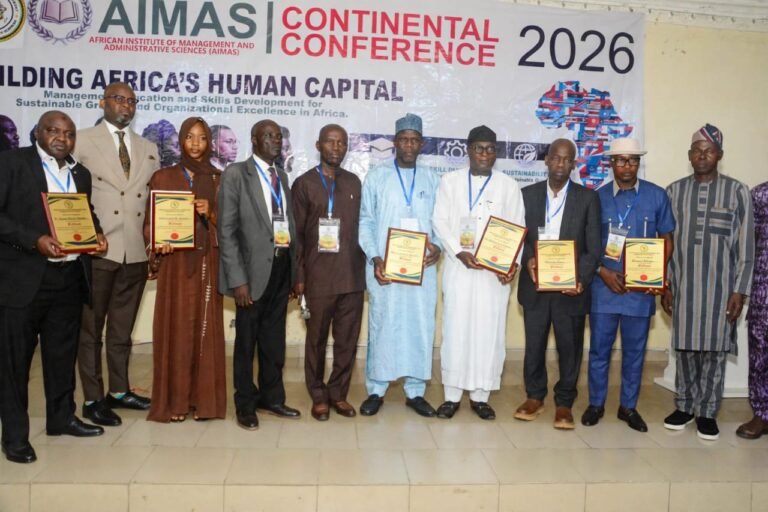
AIMAS URGES AFRICAN GOVERNMENTS TO PRIORITISE SKILLS DEVELOPMENT, EDUCATION REFORMS
By: Safiya Abdulrahim Dabban
The African Institute of Management and Administrative Sciences (AIMAS) has urged African governments to prioritise human capital development, practical education and professional skills acquisition as critical drivers of sustainable economic growth.
The institute made the call at a programme themed,“Building Africa’s Human Capital: Management Education and Skills Development for Sustainable Growth and Organisational Excellence in Africa.”
Speaking at the event, the Registrar and Secretary-General of AIMAS, Dr. O’Brien Simon, said Africa’s development depended largely on its ability to equip its people with the knowledge, technical expertise and practical skills needed to compete in an increasingly demanding global economy.
Simon lamented that despite Africa’s abundant human and natural resources, the continent had continued to struggle with maximising its potential due to challenges bordering on education, governance, accountability and resource management.
He expressed concern over the failure of some students to take industrial attachment and internship programmes seriously, noting that some obtain completed training logbooks without participating in the actual exercises.
According to him, such practices contribute to the gap between academic qualifications and workplace competence, stressing that educational achievements must be backed by practical experience and the ability to deliver results.
He further argued that academic grades should not be the sole measure of an individual’s professional competence, as graduates with lower qualifications could sometimes demonstrate better practical abilities than those with outstanding academic records.
On unemployment, Simon identified corruption, poor policy implementation, lack of transparency and accountability as major obstacles to employment generation and national development.
Other speakers at the programme called for a comprehensive reform of Africa’s educational system, emphasising the need to align academic curricula with industry requirements and emerging technological trends.
They stressed that students should be equipped with practical and management skills alongside their academic qualifications, noting that formal education alone does not guarantee professional success.
The speakers also advocated the responsible integration of Artificial Intelligence into the educational system, urging teachers and lecturers to guide students on its effective use while encouraging independent thinking, research and creativity.
A computer engineer at the event explained that the quality of responses generated by Artificial Intelligence largely depends on the instructions provided by users, describing the technology as a tool to support human intelligence rather than replace it.
The discussions further highlighted the need for governments to identify existing skills gaps, strengthen vocational and professional training, promote merit-based recruitment and improve workplace orientation.
Morocco was also cited as an example of how strategic investments in infrastructure, technical expertise and sports development could strengthen national capacity and improve international competitiveness.
The participants maintained that Africa must move beyond an education system focused primarily on certificates to one that prioritises competence, innovation, practical learning and accountability.
They called for stronger collaboration between governments, educational institutions and the private sector to build a skilled and productive workforce capable of driving the continent’s sustainable development.