

GOVERNOR BAGO UNVEILS PORTFOLIOS FOR NEW NIGER STATE COMMISSIONERS, TASKS THEM ON RESULTS
By: Safiya Abdulrahim Dabban
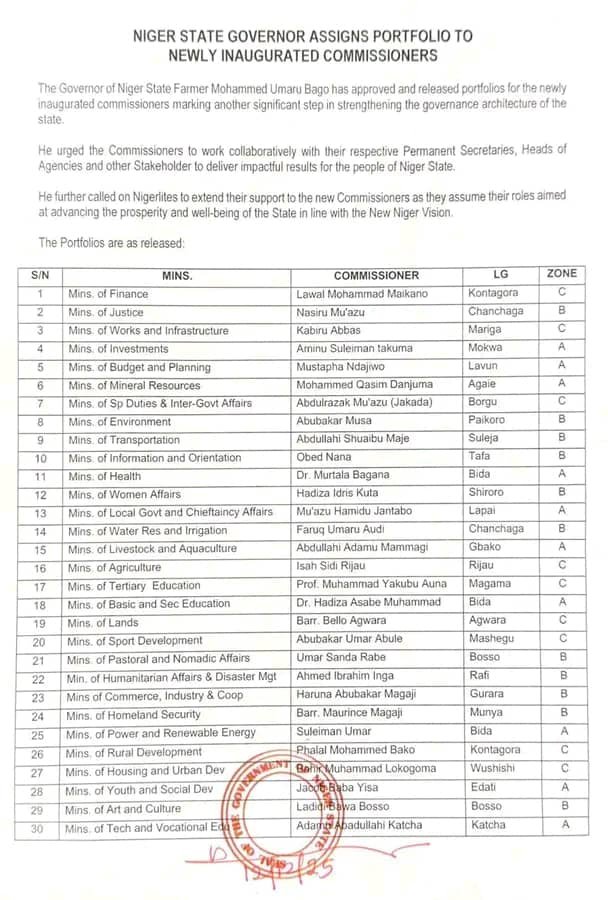
Governor Mohammed Umaru Bago has officially assigned portfolios to the newly appointed commissioners of Niger State, signaling the commencement of full executive governance under his administration and reinforcing his commitment to delivering on the New Niger Agenda.
The portfolio allocation followed the recent swearing-in of the commissioners at the Government House in Minna, an event that marked the reconstitution of the State Executive Council after weeks of consultations, screenings, and legislative confirmation by the State House of Assembly.
Governor Bago said the distribution of responsibilities was carefully done to align experience, competence, and strategic vision with the administration’s priority sectors, including infrastructure development, agriculture, education, healthcare, investment promotion, security, and social welfare. He stressed that the assignments were not ceremonial but performance-driven, warning that only commissioners who deliver measurable results would remain in office.
According to the governor, the new cabinet is expected to fast-track policies aimed at economic expansion, job creation, food security, and improved public service delivery across the state. He emphasized that Niger State must move beyond routine governance to aggressive development planning, adding that each commissioner would be held accountable for the success or failure of their ministry.
The governor also charged the commissioners to work collectively rather than in isolation, noting that inter-ministerial cooperation would be critical to achieving the administration’s development targets. He urged them to maintain transparency, prudence in public spending, and constant engagement with citizens at the grassroots.
Political observers describe the latest move as a decisive step by the Bago administration to stabilize governance and translate campaign promises into action, particularly in areas of infrastructure renewal, agricultural value chains, education reform, and investment attraction.
With portfolios now assigned, the commissioners are expected to immediately assume duties and begin implementing sector-specific policies in line with the administration’s vision of repositioning Niger State as a leading economic and development hub in Nigeria.